



Old walls refaced
Mossy walls brought back in red brick with concrete coping, and a new gate in the same opening.
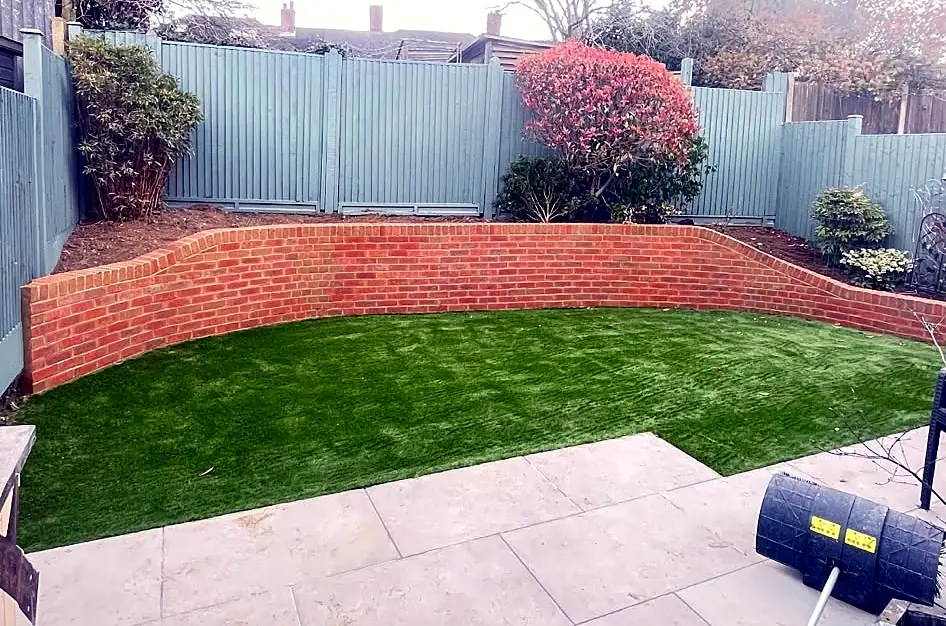

Curved retaining walls, boundary walls rebuilt, raised beds and brick seating.
Find us and review us on
Mossy walls brought back in red brick with concrete coping, and a new gate in the same opening.

A curved brick step and low wall going up on a hardcore base.

The end of a boundary wall on a bend, down and ready to be rebuilt.
Log roll edging out, a curved brick raised bed in.


From start to finish Kane was reliable, professional and quick to reply to messages. The work he did was great and was completed within the day. It was quite a tricky build as there were a lot of tree branches that the fence had to go round, but the end result was super.

Length and height, then the footing. Retaining walls are built thicker with drainage behind them; curves, piers and matching old brick take longer.
Length and height are the obvious part of a wall price; what sits underneath is the part that changes it most. A wall needs a concrete footing in a trench, deeper and wider for a taller wall or a retaining one, and if an old wall is there it has to be taken down, its footing broken out and the rubble taken away first. Retaining walls cost more than freestanding ones of the same size because they hold back soil and water, so they are built thicker, with drainage behind them, and on a slope the footing has to step. The brick matters: matching an old house brick, a curve that needs every course set out by eye, or a wall with piers and a gate opening all take longer than a straight run in a stock brick. Then the top, where brick-on-edge, concrete coping or stone coping each cost different money and do the same job of keeping rain out. Walls on a boundary can bring the Party Wall Act into play, and a wall over a metre next to a road may need planning permission. A photo with a tape measure in it is a good start.
The Party Wall Act can cover a garden wall that stands on the land of two owners, but not a wooden fence. You must tell your neighbour if you want to build on or at the boundary between your properties.
Source: Party walls and building work (printable guide), GOV.UK
To build a new wall across the boundary, or entirely on your land but up against the boundary, you must serve notice on your neighbour at least one month before work starts. The notice lasts a year. You have no right to build across the boundary without your neighbour's written consent.
Source: The Party Wall etc Act 1996: explanatory booklet, Ministry of Housing, Communities & Local Government (GOV.UK)
Hairline cracks up to 2 mm wide are common and may not be serious, but wider cracks need expert advice. The Planning Portal recommends expert advice if a wall leans more than 30 mm (half brick), 70 mm (single brick) or 100 mm (brick and a half). It also says not to repoint until the cause of the cracking is known.
Source: Fences, gates and garden walls: Building Regulations: Things to check, Planning Portal (PortalPlanQuest Ltd, joint venture of TerraQuest and MHCLG)
Fences, walls and gates do not need building regulations approval, but they must be structurally sound and kept in good repair.
Source: Fences, gates and garden walls: Building regulations: General information, Planning Portal (PortalPlanQuest Ltd, joint venture of TerraQuest and MHCLG)
As trees grow, their roots and wind-blown branches can damage a wall, and damaged sections may need rebuilding, sometimes with a bridge over the roots. Taking out a large tree can also cause problems because the soil holds more moisture and expands.
Source: Fences, gates and garden walls: Building Regulations: Things to check, Planning Portal (PortalPlanQuest Ltd, joint venture of TerraQuest and MHCLG)
We build and repair garden walls: front boundary walls, curved retaining walls, raised beds, brick seating round a fire pit, piers for gates, and new coping on old walls. Send the form with a photo and roughly how long and how high.


