



A front garden for the car
Half lawn and half broken paving, lifted and relaid as one surface, here in crazy paving freshly pointed.
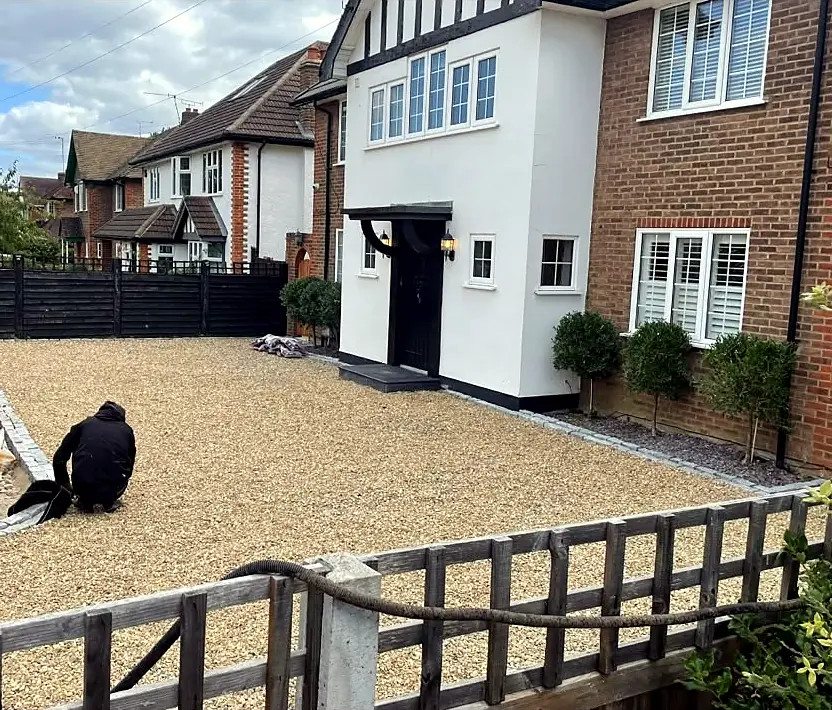

Gravel with granite setts, block paving, and failed drives put right.
Find us and review us on
Half lawn and half broken paving, lifted and relaid as one surface, here in crazy paving freshly pointed.

Grass, slate chips and cracked paving: the kind of front that a new drive replaces.

Granite setts along the borders and across the mouth hold the gravel in and give the car a clean line.


Kane came round to our house initially to assess the work and give a quote (two other firms we tried gave quotes only on the basis of photos I sent them). Kane and his assistant took away the old fence and did a thoroughly professional job on the replacement. The new fence looks fantastic and very secure and solid. I would recommend Kane's work very highly.

The base you never see again costs the most: digging out, a compacted stone base and fixed edges. Then the surface, the cutting, and where the rain goes.
The part of a drive that costs the money is the part you never see again. A drive that takes a car needs the ground dug out and a compacted base of crushed stone deep enough to spread the weight, and the edges have to be fixed so nothing can creep sideways; the July drive in our job notes failed on exactly those two things. So the first questions are how much has to come out and what it is, whether old slabs, concrete, a lawn or another drive, and whether a digger can reach it or it all leaves by barrow. Then comes the surface. Gravel is the least to lay, block paving and porcelain cost more in materials and in cutting, and a pattern such as herringbone means far more cut blocks than a straight bond. Levels and water count as well, because a drive has to fall away from the house and the rain has to go somewhere: through the surface, into a border or into a soakaway. A new dropped kerb is a separate application to the council. A photo of the drive as it is now is the quickest way to start.
A new or replacement front driveway of any size does not need planning permission if it is permeable, such as gravel, permeable block paving or porous asphalt, or if rainwater runs off to a lawn or border. If it covers more than 5 square metres and is impermeable with nowhere for the water to drain, you need planning permission.
Source: Paving your front garden: Planning permission, Planning Portal (PortalPlanQuest Ltd, joint venture of TerraQuest and MHCLG)
You need a dropped kerb to drive over the pavement onto your property, and it is illegal to do so without one. You apply to your local council to have one put in.
Source: Paving your front garden: Planning permission, Planning Portal (PortalPlanQuest Ltd, joint venture of TerraQuest and MHCLG)
Most dropped kerbs are not a planning matter, but planning permission can be needed, for example on a classified or trunk road, for flats, where structural work is needed for the parking area, or for a listed building or a property in a conservation area. The cost varies from council to council.
Source: Dropped kerbs: Planning permission, Planning Portal (PortalPlanQuest Ltd, joint venture of TerraQuest and MHCLG)
We lay new driveways and put failed ones right: gravel inside granite setts, block paving, crazy paving relaid, drives extended, edging kerbs for a new road into a yard, and the base dug out under a drive that has sunk. Send the form with a photo and a rough size, and say whether you will need a new dropped kerb.


